
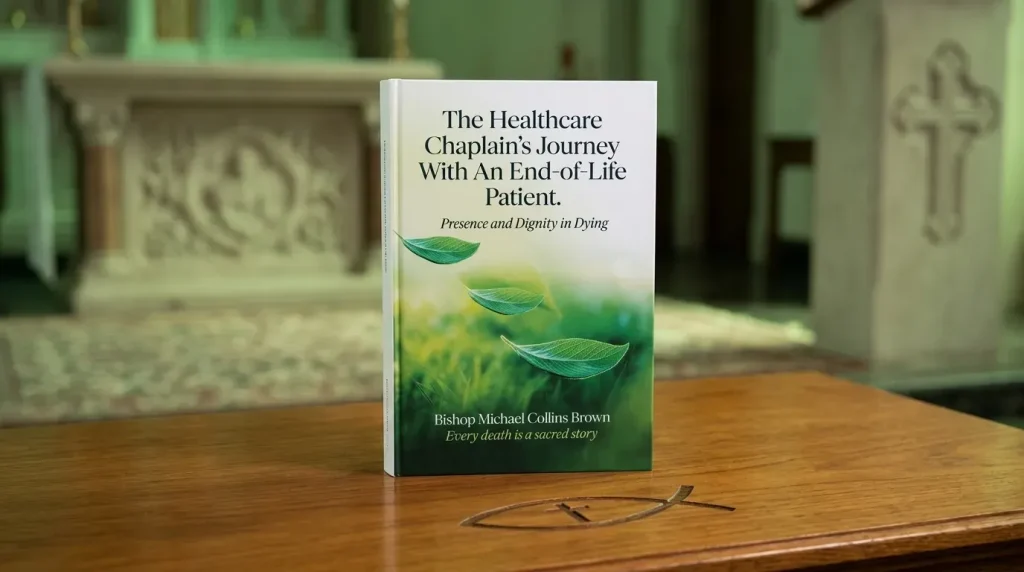
There is a particular kind of wisdom that cannot be taught in a classroom. It is the kind that forms slowly, in the spaces between what you were trained to say and what a person sitting across from you actually needs to hear. Bishop Michael Collins Brown has spent over 35 years accumulating that kind of wisdom, and his books carry every ounce of it. When readers search for Christian pastoral care books that go beyond theory, they are usually looking for something written by someone who has genuinely been in the rooms where pastoral care happens, not observed them from a distance. Bishop Brown is that author. His writing comes from hospitals, bedsides, community halls, military settings, and the kind of ministry that does not end when the service does.
Why These Christian Pastoral Care Books Read Differently
Most books on pastoral care are written from a position of relative safety. The author has processed the experience, shaped it into something instructive, and delivered it with the calm authority of someone who is no longer inside it. Bishop Brown’s writing does not always have that distance. You can feel the weight of the rooms he has occupied, the questions he has not been able to answer, and the moments when presence was the only thing he had left to offer. That closeness to the material is what makes his work genuinely useful rather than merely informative.
Chaplaincy That Crosses Cultural Lines
The most significant gap in many Christian chaplaincy books is cultural. They assume a shared framework, a common understanding of grief, healing, faith, and what spiritual care is supposed to look like. Bishop Brown makes no such assumption. Born in Ghana and shaped by decades of ministry across the UK and beyond, his understanding of pastoral care is built on the recognition that culture shapes everything, including how a person receives comfort, how they understand death, and what they need from a chaplain in their most vulnerable moments. Among Christian chaplaincy books that take cultural intelligence seriously, his stands in a category of its own.
Meeting People at the Hardest Moment
Providing spiritual care for terminal patients is one of the most demanding forms of ministry that exists. There is no script that works every time. There is no formula that reliably brings comfort when a person is facing the end of their life, and the questions they have postponed for decades are suddenly unavoidable. Bishop Brown writes about spiritual care for terminal patients with a tenderness shaped entirely by experience. He does not offer techniques. He offers presence, and the particular quality of presence he describes, patient, humble, culturally aware, and rooted in genuine faith, is something every pastoral worker can learn from.
Identity, Belonging and the Pastoral Task
One of the threads that runs through all of Bishop Brown’s writing is the question of identity. His book on Kingdom citizenship, Christian book themes, Are You a Refugee or a Citizen of the Kingdom, asks directly what it means to live as someone who belongs fully to God’s Kingdom rather than hovering at its edges in spiritual uncertainty. That question does not stay confined to one book. It runs through his entire body of work as a pastoral concern, because he has seen, again and again, that people who do not know who they are in God are far more vulnerable in crisis than those who do. His treatment of Kingdom citizenship Christian book themes is always pastoral before it is theological, always aimed at the person before it is aimed at the argument.
“Astoral care is not the application of a method. It is the offering of a person, shaped by faith, humbled by experience, and genuinely present to whoever is in the room.”
Ministry Across Cultural Contexts
For pastors and chaplains building ministry in culturally diverse settings, the Christian books on cultural care and ministry in Bishop Brown’s catalogue are among the most practically grounded available. He writes not from the perspective of someone studying diversity but from the perspective of someone who has lived it, navigated it daily, and been changed by it in ways that have made him a better minister and a more honest writer. The Christian books on cultural care and ministry he has produced are the kind that get passed between colleagues with notes in the margins, which is the highest compliment a practical theology book can receive.
What the End of Life Teaches Every Pastor
Bishop Brown’s reflections on end-of-life care from a chaplain’s perspective are among the most instructive parts of his entire body of work. He writes about what happens when a person runs out of time for the questions they have been avoiding, and about what a pastor or chaplain can actually offer in that moment, which is almost never what they were trained to offer and almost always something simpler and more human. Reading his account of end-of-life care from a chaplain’s perspective is an education in humility, presence, and the particular kind of faith that holds steady when everything else has fallen away.
Leadership Forged in Difficult Ministry
The Christian leadership and chaplaincy insights woven throughout Bishop Brown’s books are not borrowed from corporate leadership literature. They come from the experience of leading in spaces where the stakes are as high as they get, where the person across from you may not have much time left, and where the quality of your presence matters more than any strategy or communication framework ever could. For ministry leaders navigating complex institutional, cultural, and spiritual demands, these Christian leadership and chaplaincy insights are among the most grounded and honest available in print today.
Conclusion
There is no shortage of books about pastoral care. But there is a shortage of Christian pastoral care books written from the kind of experience Bishop Michael Collins Brown brings to the page. His work does not tell you how pastoral care should work in theory. It shows you how it actually works, in the rooms where people are frightened, in the cultures where grief looks different from what you expected, and in the moments when your training runs out, and all you have left is the willingness to stay. If you are in ministry, in healthcare, or simply committed to the kind of faith that shows up for people in their hardest seasons, Bishop Brown’s Christian pastoral care books belong on your shelf and in your hands.
FAQ’S
What makes Bishop Brown’s Christian pastoral care books different from others?
They are written from 35+ years of real-life experience as an NHS and Military Chaplaincy Lead, not theory. His books come directly from hospital, end-of-life, and cross-cultural encounters.
Are these books only for ordained ministers or chaplains?
No. They benefit chaplains and pastors but also speak to caregivers, families supporting the ill, and any believer exploring faith, identity, and faithful presence in hard times.
Which of Bishop Brown’s books should I read first?
Start with Are You a Refugee or a Citizen of the Kingdom for identity and belonging. Read Chaplaincy at the Crossroads of Culture and Care for healthcare chaplaincy. Choose The Healthcare Chaplain’s Journey with an End-of-Life Patient for end-of-life ministry.
Does Bishop Brown speak at events and conferences?
Yes. He speaks at churches, NHS trusts, military chaplaincy events, universities, and leadership conferences on spiritual care, cultural ministry, and Kingdom identity. Visit bishopmcbrown.com to book him.