
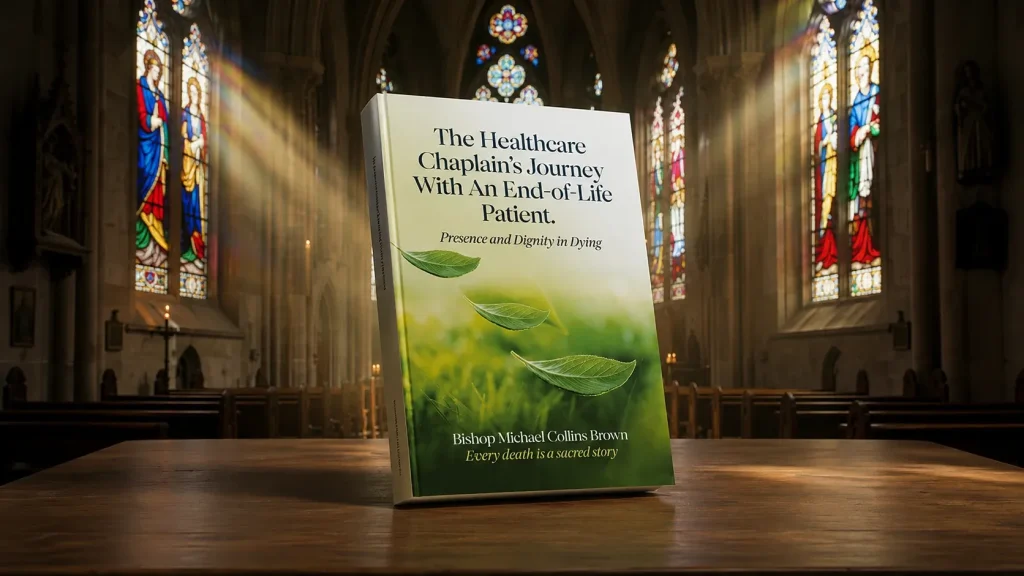
There is no one who teaches you to sit with someone who is dying. You can learn about it. You can study it. At some point, though, there you are, and all the things you thought you knew go silent. Bishop Michael Collins Brown has been there more times than most people would count on their fingers. That is what 35 years of ministry and healthcare chaplaincy will do to you! From all those many years, all those bedtime talks and nightly prayers, emerged not only wisdom, but something more. It is a collection of writing that gives a glimpse of end-of-life care from a chaplain’s perspective who feels as though it is lived-in, not studied.
How End-of-Life Care From a Chaplain’s Perspective Builds a Calling
In the beginning, Bishop Brown didn’t have titles or recognition. It started with people. But his real instructors were not great names! Instead, they were patients, grieving families and quiet moments in hospital rooms in which fear began to melt away. It was those moments that helped him to understand a lesson that we can learn in years: Being present is more important than words. Moreover, in being there, fully, with no agenda, it’s a lot to someone who is afraid.
He was taught that his faith was not about having the right answer, but about doing the right thing. Showing up, again and again, with an open heart. It’s that simple, and it’s reflected in all he has written after.
Journey of Chaplain with End-of-Life Patient Book
The Healthcare Chaplain’s Journey with an End-of-Life Patient book is about one patient’s last days, intimate and uneven, as is real life. Bishop Brown works at the speed of the difficult parts. Rather, he demonstrates the power of ordinary gestures of generosity to make an enormous difference, discreetly. A held hand. A shared silence. An unexpected moment of forgiveness. Hence, these minor details become the focal point of the narrative.
There’s something here for every nurse, doctor, chaplain and family member. Also, the book includes just one simple reminder: You don’t have to use perfect words. It’s as simple as showing up.
Chaplaincy at the Crossroads of Culture and Care Summary
Each patient is unique. The way you approach your end-of-life is influenced by your faith, language, family history and culture. So, a chaplain who ignores this is missing out on an important part. This highlights the issue of the Chaplaincy at the Crossroads of Culture and Care summary. It examines the ways in which chaplains can relate to people in their actual context, rather than where a book presumes they may be.
Some of the key lessons from this work include:
- Every patient carries a unique story shaped by culture, faith, and family
- Listening without judgment opens doors that words alone cannot
- Dignity looks different for different people, and true care means honoring that
- Cultural awareness is not optional. It is one of the most vital tools a chaplain can carry
Are You a Refugee or a Citizen of the Kingdom Book
Not all of Bishop Brown’s writing takes place in hospital rooms. Indeed, one of his most personal works is a step back from healthcare altogether. The question that cuts to the chase in the Are You a Refugee or a Citizen of the Kingdom book is where do you really belong? It gives those who have felt lost, overlooked, unsure of themselves, a rare, authentic comfort of faith and identity, not a formula or a quick fix.
Christian Leadership and Chaplaincy Insights Worth Carrying
In Bishop Brown’s writing, we see a type of leadership that is subtle and deeply rooted. His Christian leadership and chaplaincy insights as a chaplain demonstrate that when it comes to leadership, there is no greater power than listening more and speaking less. Compassion isn’t about being weak, he reminds us. In many ways, it’s the bravest thing a leader can select. Real leadership is built on consistency and being present, not charisma or titles.
Religious Support for Patients and Families
Teams are everywhere at the hospital, working on treatment. But healing is not just physical. The religious support for patients and families complements what medicine can achieve. It doesn’t have to be formal or loud. At times, it’s a brief prayer. Other times, it’s simply being in the room after everyone has left. Therefore, this type of care can be the most remembered aspect of a person’s last days, not the treatments, but the presence.
Importantly, this support is not strictly for the strong faithman, but for any and all persons of faith. Rather, it connects with others where they’re at, no pressure, no judgment.
Final Thoughts
Bishop Michael Collins Brown has been around for decades, discovering what is truly important at the end of life. In his books and ministry, he demonstrates that end-of-life care from a chaplain’s perspective is never about having the right words. Instead, it’s about coming with an open heart and repeating the process over and over. This is a gift that we can all learn to give, this kind of presence in a world that rushes past pain.
FAQs
So what is end-of-life care from a chaplain’s perspective?
It is to be with the patient, comforting, and offering spiritual encouragement during a patient’s last days. Furthermore, it is about listening, respect and no judgment, no pressure.
Whom does the book, The Healthcare Chaplain’s Journey with an End-of-Life Patient book?
There is something here for all chaplains, all nurses, all those who provide care to patients in difficult times, and for all families in difficult times. Plus, those who just want to look their best for their loved ones will relate to its message.
Are religious support for patients and families available only for those who are religious?
Not at all. It’s first about presence and comfort. In addition, it finds people where they are – both the right and the wrong people, with both strong and weak convictions.
Why is the Chaplaincy at the Crossroads of Culture and Care summary helpful to healthcare workers?
Culture influences how people perceive illness, death, hope and more. Chaplains who are knowledgeable about this can provide care that is caring, respectful and welcoming, rather than a ‘one-size-fits-all’.
What can be learned from Christian leadership and chaplaincy insights beyond hospitals?
Everywhere. Indeed, in a church, community, or workplace, listening and humble leadership in every aspect fosters deeper and more trustworthy relationships.