
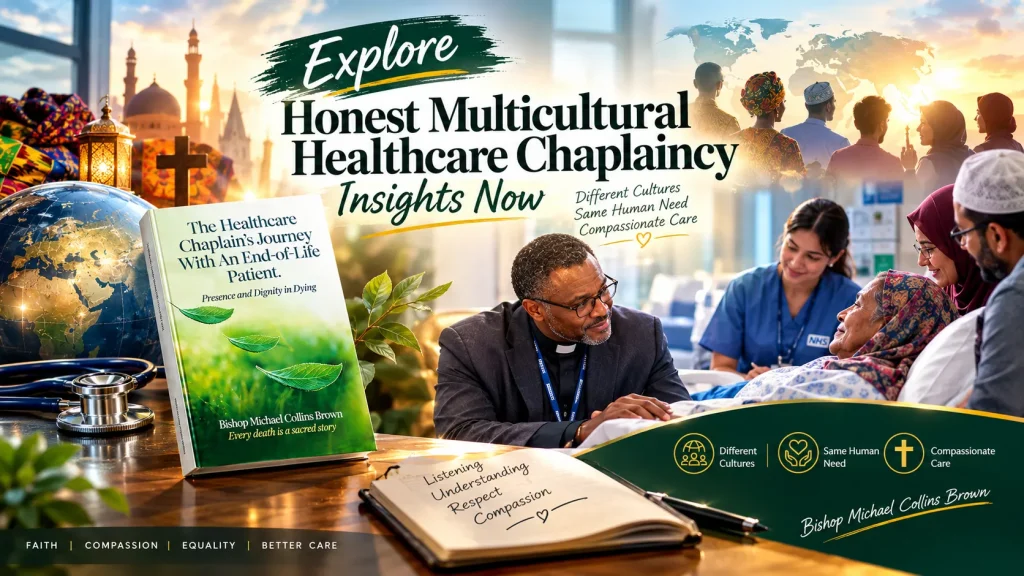
Bishop Michael Collins Brown has spent more than 35 years in ministry. Many of those years happened inside hospitals, not churches. He was born in Ghana. He now lives in the UK. He serves as NHS and Military Chaplaincy Lead for the Apostolic Pastoral Congress UK. Because of this, he offers multicultural healthcare chaplaincy insights that most training manuals skip. He is not writing from theory. He has sat with families who disagreed about how to say goodbye. So he has learned that the textbook answer rarely fits the room in front of you.
Multicultural Healthcare Chaplaincy Insights Start With Listening
Every hospital ward holds more than one culture at once. For example, a Nigerian grandmother, a Polish factory worker and a British teenager can share beds three feet apart. Each one carries a different idea of comfort. Brown says the first mistake is assuming your own instinct for comfort applies everywhere. A quiet room can feel peaceful to one family. Yet it can feel unbearably lonely to another. Some families want a crowd at the bedside. Others want space and silence instead.
Ask yourself a question. What would you want if the roles were reversed? Would you want a stranger praying over you in a language you don’t speak? Or would you rather they simply sat with you in silence? Brown has watched both preferences play out in the same week. Sometimes it happens on the same floor.
Serving Patients Whose Faith and Culture Differ From Your Own
Truth-Telling Changes by Culture
Truth telling at the bedside is one clear example. British medical practice usually expects doctors to share a diagnosis directly. However, many families from other backgrounds see that as cruel. Instead, they want to protect a parent from bad news for as long as possible. Neither approach is wrong on its face. So Brown’s role often sits in the middle of that disagreement. He translates more than language. He also translates expectation.
Still, none of this fits into a simple checklist. A family’s approach to death can shift within one generation. Because of that, a chaplain who assumes otherwise will eventually get it wrong.
Training Chaplains and Hospital Staff
Brown also trains other chaplains and hospital staff. He focuses on exactly this kind of situation. As a result, event organizers often invite him as a speaker on chaplaincy and leadership. These two subjects rarely get paired in the same room. His chaplain’s book on serving diverse patients grew directly out of these encounters. It did not come from a classroom.
A Chaplaincy Book on Culture and Care for Every Hospital Team
Brown’s book Chaplaincy at the Crossroads of Culture and Care brings these situations together. A hospital team can sit down and read it together. He does not write it like an academic manual. Instead, readers get real hospital chaplain stories. These sit alongside reflections on presence, dignity and human connection. Many groups have used the book this way. Chaplaincy teams, hospital HR departments and even seminary students have all picked it up. For them, this Chaplaincy Book on Culture and Care becomes a starting point for conversations that formal training usually skips.
Why a Multicultural Healthcare Chaplaincy Book Matters at the Bedside
A lecture on cultural awareness tends to fade within a week. A story stays with people much longer. That is because it gives them something specific to picture. Later, they can recall it the next time they walk into a similar room. This is the real argument for writing something readers can hold onto, rather than a slide deck.
Brown does not treat cultural competence in chaplaincy book form as a finished skill. In his view, it works more like a muscle. That muscle needs regular use. Otherwise, it grows weak, especially if a chaplain only serves patients who look and worship like they do. Hospitals with mixed patient populations simply cannot skip that work.
Where This Way of Working Was Shaped
Brown’s own frame of reference did not start in a hospital. First, he grew up in Ghana. Later, his ministry brought him to the UK. Since then, he has spent decades adjusting to new church cultures. He has also adjusted to new patient populations and new expectations about spiritual care. That adjustment never fully finishes, even after 35 years. Still, he describes himself as learning the room, not mastering it.
His NHS and Military Chaplaincy Lead role for the Apostolic Pastoral Congress UK keeps him in regular contact with chaplains from other faiths. As a result, his own approach never settles into one fixed style.
What Cultural Competence Does Not Look Like
Some training programs market cultural competence as a list of facts to memorize. Learn the customs for one community. Learn the rules for another religion. Then the work is supposedly done. However, Brown pushes back on that idea whenever he speaks or writes about it.
Customs shift by region, generation and personal temperament. So memorizing them only gets a chaplain partway there. For instance, a Ghanaian Pentecostal family in London may hold different expectations than that same family held back home thirty years ago. In truth, no amount of preparation removes the need to ask questions at the bedside itself. Some chaplains find that uncertainty harder to sit with than any theological debate they have had. This multicultural healthcare chaplaincy book keeps returning to that harder work.
Conclusion
None of this makes the work easy to standardize. Brown would likely say that trying too hard to standardize it misses the point. The multicultural healthcare chaplaincy insights that actually hold up under pressure come from specific rooms and specific families. They come from specific mistakes too, not from a training slide. That is probably why his writing reads more like case notes than doctrine. Chaplains looking for a shortcut past that will not find one here. Brown seems fine with that.
Frequently Asked Questions
What can multicultural healthcare chaplaincy insights actually change on a hospital ward?
Bishop Michael Collins Brown is careful not to oversell this. Better cultural awareness can reduce misunderstandings between families and staff. It can also shorten the awkward moments when nobody knows what to say. However, it rarely fixes a difficult family disagreement on its own. Brown does not claim otherwise.
Is Bishop Brown available to speak at hospitals or conferences?
Yes. He speaks regularly on faith and spiritual care in healthcare. He draws on hospital chaplain stories and decades of ministry experience across the UK healthcare system. You can find details on his website’s speaking page.
Do I need to read his other books before Chaplaincy at the Crossroads of Culture and Care?
No. Each book stands on its own. This includes The Healthcare Chaplain’s Journey with an End-of-Life Patient and Are You a Refugee or a Citizen of the Kingdom. So you can read them in any order. Still, readers who enjoy one book often want the others too.