
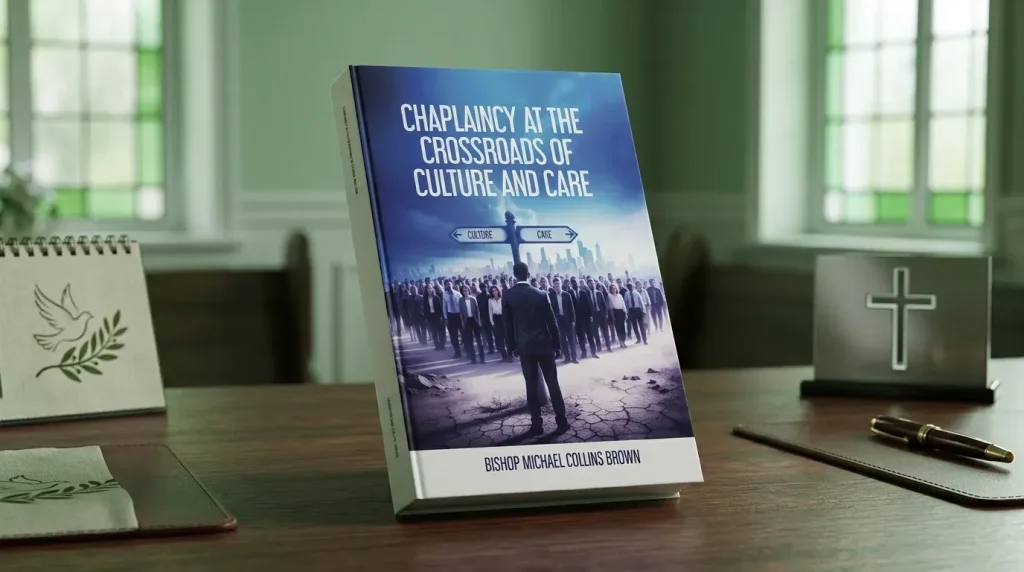
“Every hospital room holds a different world. Different beliefs, different languages, different ways of holding grief. The chaplain who walks into that room carries the weight of all of it, often with no map and very little time.”
That is the world Bishop Michael Collins Brown has inhabited for over 35 years. And Chaplaincy at the Crossroads of Culture and Care is his most direct attempt to bring that world to the page. It is not a textbook. It is not a theological treatise. It is the account of a man who has stood at the intersection of faith, culture, and human suffering, and who has learned, slowly and through experience, how to be genuinely useful in that place.
Why Chaplaincy at the Crossroads of Culture and Care Matters Now
Healthcare in the modern world is not a culturally neutral space. Patients arrive carrying the weight of their heritage, their religious convictions, their cultural understandings of illness, death, and what comes after. A chaplain who does not understand that is not fully present, no matter how well intentioned. Bishop Brown understood this long before it became part of the broader conversation in healthcare ministry, and this book is the fruit of that understanding.
Among Christian chaplaincy books available today, this one stands apart for its cultural intelligence. Bishop Brown was born in Ghana, trained across continents, and has served within the NHS in the United Kingdom, one of the most culturally diverse healthcare systems in the world. That breadth of experience is not incidental to the book. It is the foundation of it. For readers seeking Christian chaplaincy books that go beyond Western frameworks of pastoral care, this is a rare and necessary addition to the shelf.
A Journey Told With Honesty
What makes this one of the most compelling healthcare chaplain journey book titles in print is its refusal to present chaplaincy as a smooth or triumphant vocation. Bishop Brown is honest about the limits of presence. He is honest about the moments when words fail completely and all that is left is the willingness to remain in the room. He is honest about the cultural missteps that even experienced chaplains make, and about the humility required to keep learning from the people you are supposed to be serving. A healthcare chaplain journey book that told only the successes would be far less useful than this one, which tells the whole truth.
When Culture and Care Collide
There is a particular kind of tension that arises when a patient’s cultural expectations of dying do not match the clinical environment they are in. Bishop Brown has navigated that tension more times than this book can fully contain. His writing on chaplaincy and healthcare ministry is shaped by those real encounters, by the family that needed a ritual the hospital had no space for, by the patient whose faith tradition demanded a response the chaplain had never been trained to give. Understanding chaplaincy and healthcare ministry through his lens means understanding that presence alone is not enough. Cultural knowledge, genuine curiosity, and a willingness to be changed by the encounter are just as essential.
“The most important thing a chaplain can bring into a room is not certainty. It is the willingness to stay, to listen, and to let the other person’s reality matter more than your own comfort.”
The Broader Ministry This Book Serves
Bishop Brown’s writing does not stay inside the hospital walls. His reflections on Christian books on cultural care and ministry extend outward into the wider work of pastoral leadership, community engagement, and the kind of service that asks something real of the person offering it. He writes about what it means to carry another person’s grief without losing yourself, to hold space for beliefs that differ from your own, and to represent a faith that claims to serve all people while recognizing how often the structures of ministry fall short of that claim. Among Christian books on cultural care and ministry, this one is among the most practically useful precisely because it does not stay theoretical for long.
Learning From the Bedside
The sections of this book that deal with end-of-life care from a chaplain’s perspective are among the most valuable in the entire text. Bishop Brown writes about what happens in those final hours with a tenderness that never slides into sentiment. He describes the particular quality of presence that the dying seem to need, which is not explanation or reassurance but simply the dignity of being accompanied. His account of end-of-life care from a chaplain’s perspective is one that healthcare professionals, family members, and faith leaders alike will find genuinely instructive and deeply moving.
For Those Who Lead in Difficult Spaces
Beyond the bedside, this book speaks to anyone who leads in environments where faith, suffering, and institutional structures intersect. The Christian leadership and chaplaincy insights woven throughout are not drawn from management literature. They are drawn from decades of showing up in the hardest rooms and figuring out, in real time, what faithful leadership actually requires. For pastors, chaplains, healthcare leaders, and anyone building a ministry in a complex cultural context, the Christian leadership and chaplaincy insights in this book are among the most honest and applicable you will find in print.
Conclusion
There are books about chaplaincy that describe the role from the outside. And then there is Chaplaincy at the Crossroads of Culture and Care, which takes you inside it, into the rooms, the silences, the cultural gaps, and the moments of genuine human connection that make this vocation unlike any other. Bishop Michael Collins Brown has written a book that is honest about the difficulty of the work and generous in sharing what it has taught him. Whether you are a chaplain, a pastor, a healthcare professional, or simply someone who believes that faith should meet people exactly where they are, this is a book that will leave you better equipped and more deeply human for having read it.
FAQ’S
What is Chaplaincy at the Crossroads of Culture and Care about?
It is a chaplaincy book by Bishop Michael Collins Brown exploring faith, culture, and spiritual care in healthcare, especially at the end of life, based on his 35+ years of NHS experience.
Who should read this book?
Essential for healthcare chaplains, hospital pastors, faith leaders in diverse settings, and healthcare professionals seeking a deeper understanding of spiritual patient care.
Does the book address practical chaplaincy skills?
Yes. It offers practical insights from real encounters on navigating cultural differences, end-of-life presence, and compassionate care in complex environments.
Where can I find more of Bishop Brown’s work?
Visit bishopmcbrown.com for his books, blog, and speaking engagements on chaplaincy, faith, and leadership.